
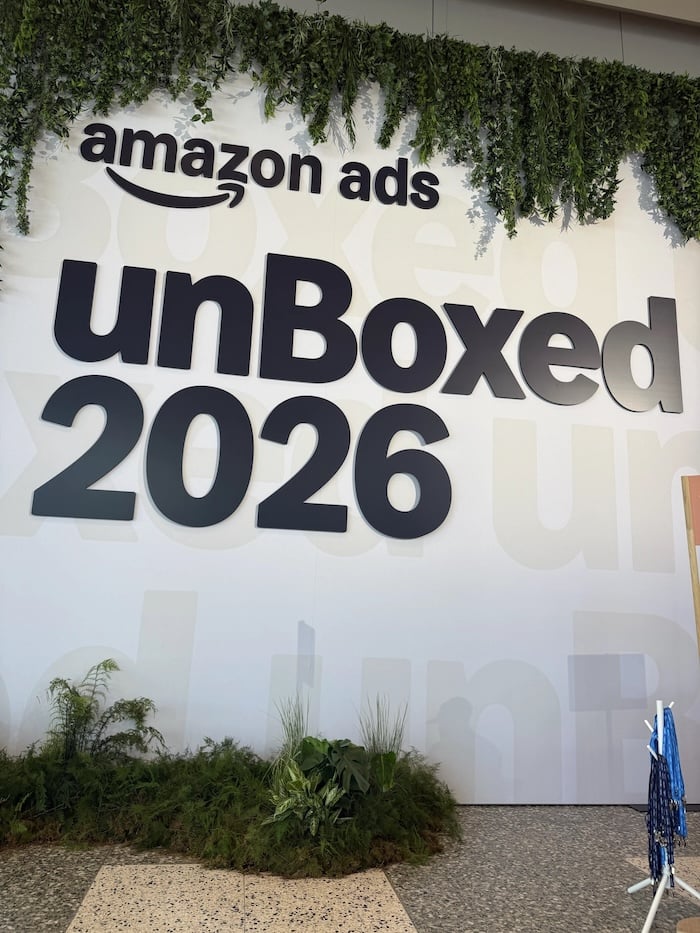
The Croud Retail Media team has just returned home from an electric week in San Francisco for Amazon Ads unBoxed 2026. Watching the keynotes unfold, the overarching vision from Amazon was crystal clear: moving seamlessly from insights to impact by dismantling execution barriers and embedding AI directly into daily campaign management.
For our clients, the most thrilling takeaway is how rapidly the ecosystem is adopting an automated, end-to-end campaign architecture. However, as Amazon consolidates its tools and pushes "agentic" AI to the forefront, the way we manage, measure, and feed these systems must adapt. Here is a wrap-up of the biggest announcements, with outlines of exactly how Croud plans to deploy these new capabilities across our client portfolio.
A Unified, Intelligent Operating System
Amazon has merged the DSP and the Ads Console into a single, AI-powered buying experience called the Amazon Ads Agent. This new unified platform features a conversational interface for setup, budget allocation, and optimization.
While this consolidation radically simplifies execution, it inherently shifts significant media allocation power to Amazon's algorithms. Our strategy is to define explicit governance guardrails that specify which actions the Agent can execute automatically versus what requires agency or brand approval. We are also benchmarking legacy DSP and Console structures now, so we can hold the unified platform accountable on transparency and performance.
Scaling Upper-Funnel Reach with Less Friction
Amazon introduced Full-Funnel Campaigns, where an advertiser sets a goal and AI handles the channel mix, audiences, and bidding. Alongside this, DVA+ was announced, a consolidated programmatic campaign type combining display, video, and audio assets under one budget.
Croud has already been actively testing full-funnel campaigns in the alpha stages to take advantage of AI-driven optimization, and seeing this roll into open beta is a huge validation of our roadmap. Moving forward, we will pilot DVA+ on mid-funnel growth ASINs to streamline execution. However, for flagship product lines, our team will strictly mandate Advanced Settings to preserve granular control over format splits, PMP deals, frequency capping, and domain exclusions. For our enterprise clients, Full-Funnel Campaigns will be run as structured tests paired with holdout groups to measure real incremental uplift.
Redefining Search and Creative
Brands can now feed proprietary product knowledge into Alexa for Shopping through Branded Conversations. This allows the AI to answer mid-funnel comparison prompts (e.g., "Help me build a skincare routine for sensitive skin") using the brand’s own structured knowledge.
However, AI raises the stakes on what you feed it; if your product content is thin or outdated, the AI will simply surface and remix that weakness at scale. We are immediately auditing our clients' Product Detail Pages (PDPs), A+ Content, and Brand Stores, and preparing prompt-and-answer maps for top hero ASINs to ensure the AI engine receives highly accurate brand messaging.
Generative AI creative tools are also now built directly into the conversational interface, enabling brands to turn static PDP images into TV-quality video and display ads. We view this as a powerful way to fill format gaps and scale production faster, but it is not a substitute for core brand storytelling. We will establish strict brand guardrails prior to wide adoption and run consistent A/B split tests comparing AI-generated creative against human-crafted performance creative.
Supercharged Analytics and the Path to Purchase
Amazon is making AMC far more accessible through the new AMC SQL Generator. Operating as an expert tool, it allows strategists to input plain-English requests and instantly receive validated, execution-ready SQL queries. This eliminates technical bottlenecks, allowing our analytics team to move from strategic hypothesis to audience activation in minutes.
We are also eagerly testing Publisher Insights to pinpoint exactly which streaming TV genres and web page categories drive genuine retail outcomes, allowing us to cut wasteful spend on overexposed audiences.
For clients whose products require setup, Amazon is extending its closed-loop advertising model to local service providers, anchored by Yelp. This Sponsored Services integration allows shoppers to book professional installation directly on the product page or post-checkout. Knowing that cart abandonment on high-ticket items often stems from installation friction, we will map catalogs for pro-install ASINs and leverage these post-checkout integrations to eliminate setup anxiety and boost conversion rates.
The Croud Blueprint: From Unboxed to Your Next Best Move
Ultimately, unBoxed 2026 confirmed that the future of retail media is all about removing operational complexity so agencies can deliver bigger commercial outcomes. To prepare for this agentic AI era, here is what we recommend brands do next:
- Audit your PDPs, A+ pages, and Brand Stores for accuracy.
- Clean and structure your customer lists and AMC audiences for immediate activation.
- Establish strict "human-in-the-loop" decision rules outlining automated threshold ranges versus mandatory human approvals.
- Deploy Full-Funnel Campaigns and DVA+ on select growth catalogs, using holdout groups to validate performance.
- Pair all Amazon-reported metrics, like Long-Term ROAS, with external Marketing Mix Modeling (MMM) and incrementality testing before reallocating holistic media budgets.
The Croud Retail Media team has returned from San Francisco energized and ready to put these new tools and AI-driven workflows to work. If you want to discuss how to structure your brand’s Amazon Ads strategy for 2027, reach out to our team today!