Last week Croud sponsored and attended ProcureCon Marketing, one of the leading gatherings for senior marketing procurement professionals in Europe. The two-day event was packed with insights and conversations around some of the topics most front of mind for marketing procurement leaders today - from AI to agency relationships to new commercial models.
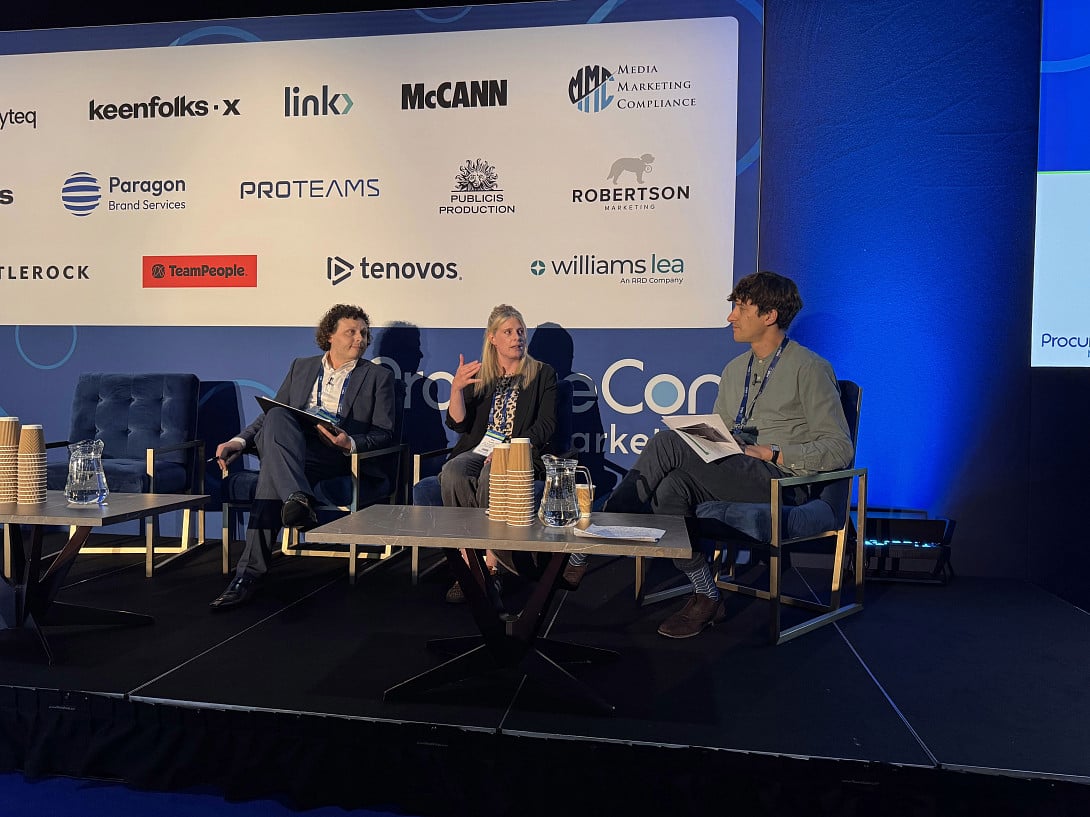
As part of the event, our Chief Growth Officer James Wilde hosted a panel discussion on one of the most pressing topics in the industry right now: how AI is reshaping search, and what that means for procurement and marketing teams trying to keep pace.
James was joined by Elise Funnell, Senior Procurement Manager at Currys, who shared a candid, in-house brand perspective, and Nick Louisson, Director of Agency Services at ISBA, who offered a broader view of what its agency members are saying. Here are some of the key takeaways from the discussion.
The search landscape has fundamentally shifted
Consumers are increasingly using AI tools like Claude, ChatGPT and Gemini for product discovery, which is having a marked impact on search click-through rates. In a recent test that we ran for some US clients, we saw a 55% drop in click-through rates as AI overviews answered user queries directly, removing the need to visit a website at all. For brands like Currys, where search has historically been a critical performance channel, this isn't a distant concern; it's happening now.
But the picture isn't entirely bleak. While overall traffic volumes may be falling, the consumers who do click through are further along in their decision-making, arriving ready to buy and representing higher value. The nature of search traffic is changing, not simply disappearing.
Autonomous purchasing is closer than you think
As part of our upcoming Croud Consumer Index, we surveyed 2,000 UK and 2,000 US consumers on their AI shopping habits. 56% of UK shoppers said they're already open to AI making purchases on their behalf without any human approval, across at least one product category.
The tipping point, where consumers are less comfortable with this, sits around £100. This aligned with Elise’s observation that smaller, lower-consideration purchases are the first to shift to AI-assisted or AI-autonomous buying, while bigger-ticket items still benefit from an omnichannel, in-store experience.
Procurement has a real role to play, but it needs to evolve
CMOs are being inundated with bold claims from a rapidly expanding landscape of AI services. Nick was direct: separating genuine capability from exaggerated promises is procurement's sweet spot. The opportunity isn't just to enable the buy; it's to actively help shape media and technology strategy.
Elise made a sharp point about foundations. Business cases for infrastructure like Product Information Management (PIM) systems, which may have previously been deprioritised due to cost or resource, are now essential. AI platforms validate the accuracy of product feeds before recommending a brand as a trusted source. If your data is wrong, you won't be recommended. The basics matter more than ever.
Measurement needs a rethink
With the fundamentals of search experiencing such a massive shift, legacy metrics are no longer applicable, and brands must redefine how they measure the success of their media investments.
In particular, last-click attribution is no longer fit for purpose. Currys is moving toward a 360-degree attribution model that combines digital attribution with econometrics modelling - and critically, running those models quarterly rather than annually. In a market moving this fast, year-old data isn't a reliable foundation for decision-making.
Agency relationships are changing too
Even for brands like Currys, with a strong in-house PPC team, the pace of change has created a clear role for specialist agency support, particularly around Generative Engine Optimisation: understanding how brands surface when consumers ask AI platforms questions, and what signals (such as digital PR, authority, parseable content) influence those recommendations.
Nick noted that agency relationships are becoming more collaborative on the media side, while content agencies are being pushed harder to adapt.
Stay curious and stay agile
The closing message from our panel was a practical one. AI discovery and behaviour is evolving quickly, but in very different ways across B2B and B2C. The frameworks you write today may be out of date by the time they're published. Build for agility, test where you can, and don't wait for a centralised playbook to arrive from head office before you start learning.
If you'd like to go deeper on the consumer AI findings, you can pre-register now to access the full Croud Consumer Index. And if you'd like to explore how Croud can help your business navigate AI search, get in touch.